Thursday, September 19, 2013

The Human Journey: Tracking Human evolution through DNA analysis

For those interested in human evolution can participate in this National Geographic experiment.

https://genographic.nationalgeographic.com/
I also sent my DNA samples for research. I was identified as belonging to the HAPLOGROUP [1] type L-M20. Find below the DNA analysis provided by National geographic to me. So looks like although there is no proof that we are descended from monkeys and apes, but we are all certainly descended from an African human male who lived in Africa 140,000 yrs.

Interestingly, this analysis is only for paternal lineage. The puzzle and riddle that has arisen from this study is that there is evidence of mass FEMALE only migrations distinct from mass MALE only migrations. Scientists do not have an answer as to why there were MALE ONLY migrations and FEMALE only migrations. Also, the first male genetic marker goes back to 140,000 yrs old. However, the female genetic marker is more than 140,000 yr old. Which means that Eve lived as a single female human lot longer than the male human Adam.

The common direct paternal ancestor of all men alive today was born in Africa around 140,000 years ago. He was neither the first human male nor the only male alive in his time. He was the only male whose offspring survived and spread out of Africa to colonize the planet. Most men, including your direct paternal ancestors, trace their ancestry to one of this man’s descendants. Dubbed “Y-chromosome Adam” by the popular press, he was neither the first human male nor the only man alive in his time. He was, though, the only male whose Y-chromosome lineage is still around today.  All men, including your direct paternal ancestors, trace their ancestry to one of this man’s descendants. The oldest Y-chromosome lineages in existence, belonging to the A branch of the tree, are found only in African populations.

Your branch of this lineage took part in the out-of-Africa migrations. They spread to the border region between West and South Asia around 30,000 years ago. Many from this lineage settled South Asia.

Branch: M42

Age: About 75,000 Years Ago

Location of Origin: Africa


Around 75,000 years ago, the BT branch of the Y-chromosome tree was born, defined by many genetic markers, including M42. The common ancestor of most men living today, some of this man’s descendants would begin the journey out of Africa, to India and the Middle East. Small groups would eventually reach the Americas. Others would settle in Europe, and some from this line remained near their ancestral homeland in Africa. Individuals from this line in Africa often practice cultural traditions that resemble those of their distant ancestors. For example, they often live in traditional hunter-gatherer societies. These include the Mbuti and Biaka Pygmies of central Africa, as well as Tanzania’s Hadza As M42-bearing populations migrated around the globe, they picked up additional markers on their Y-chromosomes. Today, there are no known BT individuals without these additional markers.

Branch: M168

Age: About 70,000 years ago

Location of Origin: Africa/Asia


As humans left Africa, they migrated across the globe in a web of paths that spread out like the branches of a tree, each limb of migration identifiable by a marker in our DNA. For male lineages, the M168 branch was one of the first to leave the African homeland. Moving outward from Africa and along the coastline, members of this lineage were some of the earliest settlers in Asia, Southeast Asia, and Australia. Some from this line would even travel over the land bridge to reach the Americas.
The man who gave rise to the first genetic marker in your lineage probably lived in northeast Africa in the region of the Rift Valley, perhaps in present-day Ethiopia, Kenya, or Tanzania.  Scientists put the most likely date for when he lived at around 70,000 years ago. His descendants became the only lineage to survive outside of Africa, making him the common ancestor of every non-African man living today.

But why would man have first ventured out of the familiar African hunting grounds and into unexplored lands? The first migrants likely ventured across the Bab-al Mandeb strait, a narrow body of water at the southern end of the Red Sea, crossing into the Arabian Peninsula soon after M168 originated—perhaps 65,000 years ago. These beachcombers would make their way rapidly to India and Southeast Asia, following the coastline in a gradual march eastward.  By 50,000 years ago, they had reached Australia. These were the ancestors of today’s Australian Aborigines.


It is also likely that a fluctuation in climate may have contributed to your ancestors’ exodus out of Africa. The African ice age was characterized by drought rather than by cold. Around 50,000 years ago, though, the ice sheets of the northern hemisphere began to melt, introducing a short period of warmer temperatures and moister climate in Africa and the Middle East. Parts of the inhospitable Sahara briefly became habitable. As the drought-ridden desert changed to a savanna, the animals hunted by your ancestors expanded their range and began moving through the newly emerging green corridor of grasslands.


Your nomadic ancestors followed the good weather and the animals they hunted, although the exact route they followed remains to be determined. In addition to a favorable change in climate, around this same time there was a great leap forward in modern humans’ intellectual capacity. Many scientists believe that the emergence of language gave us a huge advantage over other early human species. Improved tools and weapons, the ability to plan ahead and cooperate with one another, and an increased capacity to exploit resources in ways we hadn’t been able to earlier, all allowed modern humans to rapidly migrate to new territories, exploit new resources, and replace other hominids such as the Neanderthals.

Branch: M89

Age: Around 50,000 Years Ago

Location of Origin: South Asia or West Asia


The next male ancestor in your ancestral lineage is the man who gave rise to M89, a marker found in 90 to 95 percent of all non-Africans. This man was born around 50,000 years ago in northern Africa or the Middle East.


The first people to leave Africa likely followed a coastal route that eventually ended in Australia. Your ancestors followed the expanding grasslands and plentiful game to the Middle East and beyond, and were part of the second great wave of migration out of Africa.


Beginning about 40,000 years ago, the climate shifted once again and became colder and more arid. Drought hit Africa and the grasslands reverted to desert, and for the next 20,000 years, the Saharan Gateway was effectively closed. With the desert impassable, your ancestors had two options: remain in the Middle East, or move on. Retreat back to the home continent was not an option.


While many of the descendants of M89 remained in the Middle East, others continued to follow the great herds of wild game through what is now modern-day Iran to the vast steppes of Central Asia.

These semi-arid grass-covered plains formed an ancient “superhighway” stretching from eastern France to Korea. Your ancestors, having migrated north out of Africa into the Middle East, then traveled both east and west along this Central Asian superhighway. A smaller group continued moving north from the Middle East to Anatolia and the Balkans, trading familiar grasslands for forests and high country.


Today, geneticists have found the lineage in 1 to 2 percent of Pakistani and Indian populations. However, it is about 4 percent of some Austro-Asiatic-language-family-speaking groups in India. It is about 9 percent of some Dravidian-language-family-speaking groups in India, and it is 9 to 10 percent of male lineages in Sri Lanka. In Borneo, it is about 5 percent of the population. In Malaysia, it is about 6 percent of the population.

Branch: P128

Age: About 45,000 years ago

Location of Origin: South Asia


The next male ancestor in your ancestral lineage is the man who gave rise to P128, a marker found in more than half of all non-Africans alive today. This man was born around 45,000 years ago in the Middle East or Central Asia.


The descendants of P128 migrated to the east and north, picking up additional markers on their Y-chromosomes. This lineage is the parent of several major branches on the Y-chromosome tree: O, the most common lineage in East Asia; R, the major European Y-chromosome lineage; and Q, the major Y-chromosome lineage in the Americas. These descendant branches went on to settle the rest of Asia, the Americas, and Europe; many others traveled to Southeast Asia.Today, P128 individuals lacking these additional markers are rare in most populations, and are most commonly seen in Oceanian and Australian Aboriginal populations. 

Branch: M20

Age: About 30,000 Years Ago

Location of Origin: South Asia or West Asia


Traveling hunters, this man and his early descendants lived on the big game of the grass savannas of Asia. Today, this lineage has a moderate frequency in India (about 10 percent). However, in many isolated population groups in southern India the frequency is much higher. It makes up a striking 48 percent of Kallar male lineages in southern India. It is 9 to 10 percent of the male population among Bukharan Arabs. It is 4 to 5 percent of the Uyghur population. It is 1 to 2 percent of the Hui population. In Turkey, it varies between 12 and 57 percent, depending on the region tested.

Tuesday, January 3, 2012

The 7 Habits of Highly Effective People

Selected passages from Stephen R. Covey's famous best seller; The 7 Habits of highly effective people.


       As my study took me back through 200 years of writing about success, I noticed a startling pattern emerging in the content of the literature. Because of our own pain, and because of similar pain I had seen in the lives and relationships of many people I had worked with through the years, I began to feel more and more that much of the success literature of the past 50 years was superficial. It was filled with social image consciousness, techniques and quick fixes -- with social band-aids and aspirin that addressed acute problems and sometimes even appeared to solve them temporarily -- but left the underlying chronic problems untouched to fester and resurface time and again.
Page 8.


       In stark contrast, almost all the literature in the first 150 years or so focused on what could be called the character ethic as the foundation of success -- things like integrity, humility, fidelity, temperance, courage, justice, patience, industry, simplicity, modesty, and the Golden Rule. Benjamin Franklin's autobiography is representative of that literature. It is, basically, the story of one man's effort to integrate certain principles and habits deep within his nature. The character ethic taught that there are basic principles of effective living, and that people can only experience true success and enduring happiness as they learn and integrate these principles into their basic character.
Page 8


       But shortly after World War I the basic view of success shifted from the character ethic to what we might call the personality ethic. Success became more a function of personality, of public image, of attitudes and behaviors, skills and techniques that lubricate the processes of human interaction. This personality ethic essentially took two paths: one was human and public relations techniques, and the other was positive mental attitude (PMA). Some of this philosophy was expressed in inspiring and sometimes-valid maxims such as "Your attitude determines your altitude," "Smiling wins more friends than frowning," and "Whatever the mind of man can conceive and believe it can achieve. Other parts of the personality approach were clearly manipulative, even deceptive, encouraging people to use techniques to get other people to like them, or to fake interest in the hobbies of others to get out of them what they wanted, or to use the "power look," or to intimidate their way through life. Some of this literature acknowledged character as an ingredient of success, but tended to compartmentalize it rather than recognize it as foundational and catalytic. Reference to the character ethic became mostly lip service; the basic thrust was quick-fix influence techniques, power strategies, communication skills, and positive attitudes. 
Page 8


     If I try to use human influence strategies and tactics of how to get other people to do what I want, to work better, to be more motivated, to like me and each other -- while my character is fundamentally flawed, marked by duplicity and insincerity -- then, in the long run, I cannot be successful. My duplicity will breed distrust, and everything I do -- even using so-called good human relations techniques -- will be perceived as manipulative. It simply makes no difference how good the rhetoric is or even how good the intentions are; if there is little or no trust, there is no foundation for permanent success. Only basic goodness gives life to technique.
Page 9


    The glitter of the personality ethic, the massive appeal, is that there is some quick and easy way to achieve quality of life -- personal effectiveness and rich, deep relationships with other people – without going through the natural process of work and growth that makes it possible It's symbol without substance. It's the "get rich quick" scheme promising "wealth without work."

    And it might even appear to succeed -- but the schemer remains.

    The personality ethic is illusory and deceptive. And trying to get high-quality results with its techniques and quick fixes is just about as effective as trying to get to some place in Chicago using a map of Detroit.
Page 12

    I have seen the consequences of attempting to shortcut this natural process of growth often in the business world, where executives attempt to "buy" a new culture of improved productivity, quality, morale, and customer service with the strong speeches, smile training, and external interventions, or through mergers, acquisitions, and friendly or unfriendly takeovers. But they ignore the low-trust climate produced by such manipulations. When these methods don't work, they look for other personality ethic techniques that will -- all the time ignoring and violating the natural principles and processes on which high-trust culture is based.
Page 18


Living with Less by Leo Babauta

Selected passages from "Living with Less" by Leo Babauta.


  • "In the middle of difficulty lies opportunity" -  
Albert Einstein.


  • The problems of our economy stem from unchecked consumerism - people buying houses too expensive for their incomes, getting into too much debt by spending too much, living a lifestyle of more and more with the idea that things will only continue to get better.
Page 4.


  • There is no crime greater than having too many desires;
    There is no disaster greater than not being content;
    There is no misfortune greater than being covetous.
    Hence in being content, one will always have enough.
Lao Zi. Chinese philosopher


  • "Earth provides enough to satisfy every man's need, but not every man's greed."
Mahatma Gandhi

  • Its consumerism, and it's the official religion of the industrialized world.
Page 10


  • "We are what we repeatedly do. Excellence then, is not an act, but a habit."
Aristotle

Monday, October 10, 2011

The Social Workplace

Lately, I have been thinking of an idea where Facebook style social networking technology can be used to reshape the workplace.

Technically, the idea is to put a working copy of Facebook ( or a similar copycat) on a server and put the Facebook server inside the corporate LANs of big multinational companies. By big, I mean MNCs which have employees in thousands. For example, IBM has around 300,000 full time permanent employees working around the world.

Now, how does a MNC which is spread around the globe benefit from such social networking and that too in the workplace? Well, imagine this; how many Googlers have instant access to what their CEO is thinking? How many IBMers can "Like", "Agree", "Disagree", "Share" or "Comment" on what IBM CEO Sam Palmisano thinks or says. It seems that company's like Google and Facebook are already harnessing the power of social network to re-shape the corporate workplace into a social workplace. E.g. Google employees and the general public can read what Larry Page is thinking, reading or sharing at his workplace by simply visiting the the URL below

https://plus.google.com/106189723444098348646/posts/4wkYwTCCgAc

Sergey Brin from Google also has his social networking presence which can be visited by visiting the URL below

https://plus.google.com/109813896768294978296/posts/dwmWyNSoXTh

Facebook founder, Mark Zuckerberg can be followed on the following URL

https://www.facebook.com/zuck

What if the IBM's CEO can instantaneously share his thoughts with the IBMers across the globe with a "status" update. A status, shared with "friends", "followers" or "subscribers" would spread an idea or an opinion much faster than a corporate email which by the way comes from an anonymous email address with the boring caution "Do not reply to this message as the mailbox is not monitored" at the end of it.

What if IBMers can comment, share and like the status update of their CEO.  News would spread much faster with a status update than it would with a corporate email.  Senior management would be able to gauge the response to a particular proposal by counting the number of "Likes".

What if professional networking is replaced by socio-professional networking. The work place would be a lot more fun to work if I can know who I am working with and how many people share the same interests and hobbies with me.

Social networking has already revolutionarised  our social lives. It can be used to add the human and social touch to our workplace as well.

Saturday, June 11, 2011

Main baaghi hoon, written by Dr. Khalid Javed Jan during Zia ul Haq’s tenure

A famous literary master piece written by Dr. Khalid Javed.

is daur k rasm riwaajon se,
in takhton se inn tajoon se,
jo zulm ki kokh se jante hain,
insani khoon se palte hain,
jo nafrat ki bunyadain hain
aur khooni khet ki khadein hain,
main baghi hoon main baghi hoon
jo chahe mujh pe zulm karo

I am a rebel,
From the norms and traditions of the time,
From the thrones and the crowns,
Which are born from the womb of cruelty,
Which feed of the human blood,
Which are the foundations of hate,
And are the fertilisers of the killing fields,
I am a rebel, I am a rebel
Do what ever you may unto me.

wo jin k hont ki jambish se,
wo jin ki aankh ki larzish se,
qanoon badalte rehte hain,
aur mujhrim palte rehte hain,
in choroon k sardaron se
insaaf k pahre daron se
main baghi hoon main baghi hoon
jo chahe mujh pe zulm karo


mazhab k jo byopari hain,
wo sab se bari bemari hain,
wo jin k siwa sab kafir hain,
jo deen ka harf-e-akhir hain,
in jhute aur makkaron se
mazhab k thekedaron se
main baghi hoon main baghi hoon
jo chahe mujh pe zulm karo

mere hath main haq ka jhanda hai,
mere sir pe zulm ka phanda hai,
main marne se kab darti hoon,
main moat ki khatir zinda hoon,
mere khoon ka suraj chamke ga
to bacha bacha bole ga
main baghi hoon, main baghi hoon
jo chahe mujh pe zulm karo

Thursday, January 1, 2009

New Year Eve 2009. Sydney

New yr eve 2009 at Sydney as viewed from North Bondi.

From New Yr Eve 2009


New Yr eve 2009 sunset video.


New Yr eve 2009 fireworks video

Sunday, December 28, 2008

Pakistanis must apologise

Every Pakistani whether living abroad or in Pakistan was deeply touched by the tragedy of Mumbai attacks. Attacks like the one in Mumbai occur on a routine basis ever since Pakistan joined the Global War on Terror, however, the attacks in Mumbai were of greater concern to Pakistanis then the attacks of Marriot, carnage at PPP election rallies, the attacks of US drones in FATA and the attacks by suicide bombers on regular intervals in different cities . Reason being that the last time when the such an attack of such proportions was carried out in India, back in 2002, India threatened Pakistan with a full scale military invasion and amassed its troops along the Pakistani border. As of current standing, Pakistan and Pakistanis really cannot afford to have another war right in the middle of an ongoing war of which there seems to be no end.

Just like most Pakistanis, I was very much concerned by what was going to happen next. I was very much aware that India had enough of it and if this was really the handiwork of a Pakistan based group, India would certainly like to do some thing about it. I was also worried that may be its another ISI sponsored fiasco to settle the score for whats going on in FATA and Balochistan (whether thats true of wrong is certainly questionable) . And of course their were conspiracy theories as well (Mossad, Col Purhoit et al blah blah.)

Soon after the blasts, Indian gov and all the Indian media outlets declared that India had enough evidence to prove that the attackers came from Pakistan. The statements from the Indian side, both gov and media, did not clarify what they meant by "Pakistan". Did the evidence indicate that the attacks were sanctioned by the government of Pakistan, the attackers trained by Pakistani army OR did the Indian gov and media meant that the attackers, though, were not sent by the gov of Pakistan, but were Pakistani citizens, trained and equipped by rogue Jihadi groups in Pakistan?

From the history of Indo-Pak relations, I and every Pakistani know that there is quite a good chance that the attackers are Pakistanis. Even if they are Indian Muslims, upset with the treatment meted out to them at the hands of the Indian gov, there must be some sort of Pakistani involvement in arming and training them. By Pakistani I do not necessarily mean Pakistani gov but Pakistan based jihadi outfits.

Now as usual, the Indian gov and the Indian media started pointing fingers towards Pakistan. What was meant by Pakistan was left undefined. Many Pakistanis took it as an accusation towards the state of Pakistan and each and every Pakistani. Both sides quickly descended into a war of words. The war of words was fought both on the gov level, in cyber space and as well as in a personal capacity. I too quickly got involved in fiery debates with some of my Indian friends and got carried away with my nationalistic sentiments.

With the war cry becoming louder from both sides, I started posting stories of how the Indian gov has still not provided any evidence even though one month has passed since the attacks took place. Whipping up the dead horse of Kashmir, right when the relations between India and Pakistan are at their lowest, also became part of the justification. Slowly after one month, the issue was no longer the attacks in Mumbai but how Pakistan had been supporting insurgency in Indian Kashmir and how India had been stubbornly sitting on top of the Kashmir issue.

Finally, one day I realized that keeping in mind the historical data, I should simply say a sorry to my Indian friends and apologize rather then trying to split hairs by bringing up discrepancies found in the various accounts of the Mumbai attacks as narrated by various media outlets. This is exactly what both the governments of Pakistan and India are right now involved in. The Indian gov, trying to do some face saving in front of a nation angry and humiliated at the hands of 20 or few gunmen while the Pakistani gov trying to put up a brave face in front of accusations and threats being hurled from the Indian side. No wonder, time and again, both India and Pakistan, gov and people, end up, back at square one as they were in 1947.

It is very much the responsibility of the Indian gov to provide the evidence it has claimed to have from day one, but mean while the Indian gov prepares the evidence, Pakistani gov should not sit idle and make its own efforts to investigate the attacks. Pakistani gov can rid itself of the stain and stigma of sponsoring terrorists only by making serious and honest efforts to investigate. Though the Pakistani gov is justified in asking for evidence, still it will be better if it doesn't wait for evidence. It should treat this matter with the same urgency as it would have treated a similar incident of terrorism in the UK or the US.

What about the people? Pakistanis and Indians? Well to all Pakistanis, I would say that keeping in mind our history, there is a good enough chance of this being the handiwork of our country men. Whether gov sponsored or independent non state actors. So there is no harm in apologising. If it turns out , much as I would wish, that the perparators were not Pakistanis, we would have lost nothing. However, if it turns out that the terrorists were indeed Pakistanis, we would have lost a lot by then.

To all my Indian friends, I apologize twice.

Once for what ever happened and hope it is not repeated ever again.

Secondly, I also apologize for taking this long to apologize. This apology should have come on the very first day.

The story of two beggars

Tahir and Habib are London beggars. They beg in different areas of the West End. Habib begs just as long as Tahir but only collects £10-15 every day.

Tahir brings home a suitcase FULL of £10 notes every day, drives a Mercedes, lives in a mortgage-free house and has a lot of money to spend.

Habib says to Tahir 'I work just as long and hard as you do but how do you bring home a suitcase full of £10 notes every day?'

Tahir says, .... 'Look at your sign, what does it say'?

Habib's sign reads 'I have no work, a wife and 6 kids to support'.'

Tahir says ' No wonder you make no more than £15 a day

Habib says... 'So what does your sign say'?

Tahir shows Habib his sign......It reads,,,,

'I only need another £10 to move back to Pakistan'.

Friday, December 26, 2008

Appeal for Donations to wikipedia

Wikipedia Affiliate Button


An appeal from Wikipedia founder, Jimmy Wales

Jimmy Wales

Dear Reader,

Today I am going to ask you to support Wikipedia with a donation. This might sound unusual: Why does one of the world's five most popular web properties ask for financial support from its users?

Wikipedia is built differently from almost every other top 50 website. We have a small number of paid staff, just twenty-three. Wikipedia content is free to use by anyone for any purpose. Our annual expenses are less than six million dollars. Wikipedia is run by the non-profit Wikimedia Foundation, which I founded in 2003.

At its core, Wikipedia is driven by a global community of more than 150,000 volunteers - all dedicated to sharing knowledge freely. Over almost eight years, these volunteers have contributed more than 11 million articles in 265 languages. More than 275 million people come to our website every month to access information, free of charge and free of advertising.

But Wikipedia is more than a website. We share a common cause: Imagine a world in which every single person on the planet is given free access to the sum of all human knowledge. That's our commitment.

Your donation helps us in several ways. Most importantly, you will help us cover the increasing cost of managing global traffic to one of the most popular websites on the Internet. Funds also help us improve the software that runs Wikipedia -- making it easier to search, easier to read, and easier to write for. We are committed to growing the free knowledge movement world-wide, by recruiting new volunteers, and building strategic partnerships with institutions of culture and learning.

Wikipedia is different. It's the largest encyclopedia in history, written by volunteers. Like a national park or a school, we don't believe advertising should have a place in Wikipedia. We want to keep it free and strong, but we need the support of thousands of people like you.

I invite you to join us: Your donation will help keep Wikipedia free for the whole world.

Thank you,

Jimmy Wales

Wednesday, December 3, 2008

Sculptures by the sea


One of the most unique and amazing exhibition of scultptural art.


Kempsie


The lonely beach littered with tree trunks.


The TableLands

Away from the coastal paradise, inside the Australian mainland lies the lush green fields of Tamworth, Lismore and Taree.


Urunga Lagoon


An oasis of serenity in the midst of turbulence and chaos


Tuesday, December 2, 2008

Gold Coast

Gold Coast is an urban paradise.

Byron Bay

Byron Bay is one of the most beautiful and scenic places of Australia.

Have a look at some of the pics.

Sunday, September 7, 2008

Spit to Manly


Sydney has been blessed with some of the world's most exotic landscape. Oceanic views, forest bush land and a diverse flora and fauna are all part of the beautiful Sydney.

Around Sydney, one can embark on a number of scenic oceanic walks. The Bondi to Cogee walk takes you from the famous Bondi beach to the Cogee beach via Tamaramma, Bronte, Clovelly and Gordon's Bay.

A complete list of parks, walks and camping places can be found by visiting the following URL

Department of environment: Gov of NSW


Another famous walk starts from the Spit Bridge and end at the Manly beach. The walk is 10 KMs long and goes through a variety of landscapes which include, rain forest, mountains, cliffs and harbour side residential areas.


Last weekend, I along with my friend went on an expeditionary trip to explore the trek and take some pics of the beautiful sights one can come across.

I have placed a slide show below.

Enjoy

Saturday, July 26, 2008

Sydney in Winters

Last weekend I went out with one of my friend, Waqas, on a shooting spree. Yes a picture shooting spree of the most beautiful spots of Sydney.


Unlike other parts of the world, Sydney still retains it spring-time like beauty through out the year and even in winter.

Here are some glimpses of Sydney's winter beauty.


Sunday, July 13, 2008

Son of Lion: Benjamin Gilmour


Son of a Lion; Warrior Poets. A Pashtun lad challenges his father's authority by refusing the future mapped out for him in an area of the Hindu Kush mountains where weapons are manufactured.


It just happened to be a co-incidence that I met Benjamin Gilmour, a Sydney paramedic by profession and a movie maker by passion.

A friend of mine sent me an email telling me of some one who had visited Pakistan and fell in love with the culture and people of the North West Frontier Province, N.W.F.P. Such was the intensity of his love for Pathans that he decided to make a movie which brushes aside all stereotypes of Pathans and narrates the story of an ordinary village boy who is born into a family of gun manufacturers but wants to give up working as a gun manufacturer and pursue his formal education.

The name of the movie which Mr. Gilmour directed is "Son of a Lion" starring local characters and local actors. The story revolves around a young boy from the town of Darra Adam Khel, whose father is a gun manufacturer by profession. The father of the boy wants his son to follow in the foot steps of his father and also become a gun manufacturer, however, the boy is interested in getting a decent education.

The movie has been shot in Darra Adam Khel during 2005-2006. The Australian Film Council funded the venture and Gilmour, who had never directed a movie, shot all the scenes and authored the script of the movie.


The movie has been featured in many film festivals around the world and a google search reveals more then 25, 300, 000 results. The movie has already won numerous awards in the Australian film festival.

Mr. Gilmour from the obscurity of a Sydney parademic has become an authority on the geo-political affairs of the area and is often invited in numerous radio and TV talk shows to present his views on the on-going conflict in the region.

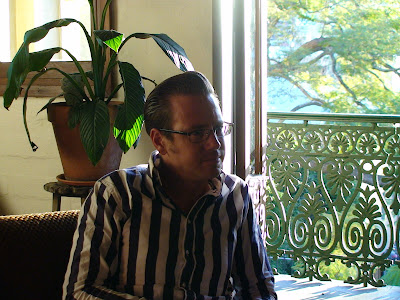
Benjamin Gilmour: At his Sydney residency


Gilmour is deciding to make more documentaries on Pathans and the contribution of Pathans in the economic development of early 19th and 20th century Australia. Gilmour is interested in making more documentaries which show case the contribution of Pathans in economic success of Australia in the form of Ghan railway line which runs through the rugged, treacherous and dangerous terrain of the Australian outback.